


In the immediate aftermath of Canada’s federal election, CyberWell, the tech-driven nonprofit combating online antisemitism, has released new information documenting a rise in antisemitic content across major social media platforms during the election campaign. The findings point to an alarming trend of conspiratorial and hate-fueled rhetoric targeting Jewish political figures and promoting classic antisemitic tropes throughout the democratic process.
Between August 2024 and April 2025, CyberWell used its AI-powered monitoring tools to flag and analyze online content tied to the Canadian federal election. Analysts manually verified 86 posts as antisemitic in accordance with the International Holocaust Remembrance Alliance (IHRA) working definition of antisemitism. These posts were found across Facebook, Instagram, TikTok, X (formerly Twitter), and YouTube, and reach beyond the borders of Canada.
This 86-piece dataset alone gained over 65,600 views and reached an engagement rate of 5,312 across social media platforms, according to social listening tools that CyberWell utilizes.
The antisemitic rhetoric was most heavily concentrated around two leading candidates: Liberal Party Prime Minister Mark Carney and Conservative Party Leader Pierre Poilievre. Additional Jewish political figures, including MP Melissa Lantsman (CPC) and Immigration Minister Rachel Bendayan (LPC), were also targeted with antisemitic attacks, often focusing on their Jewish identity, appearance, or sexual orientation.
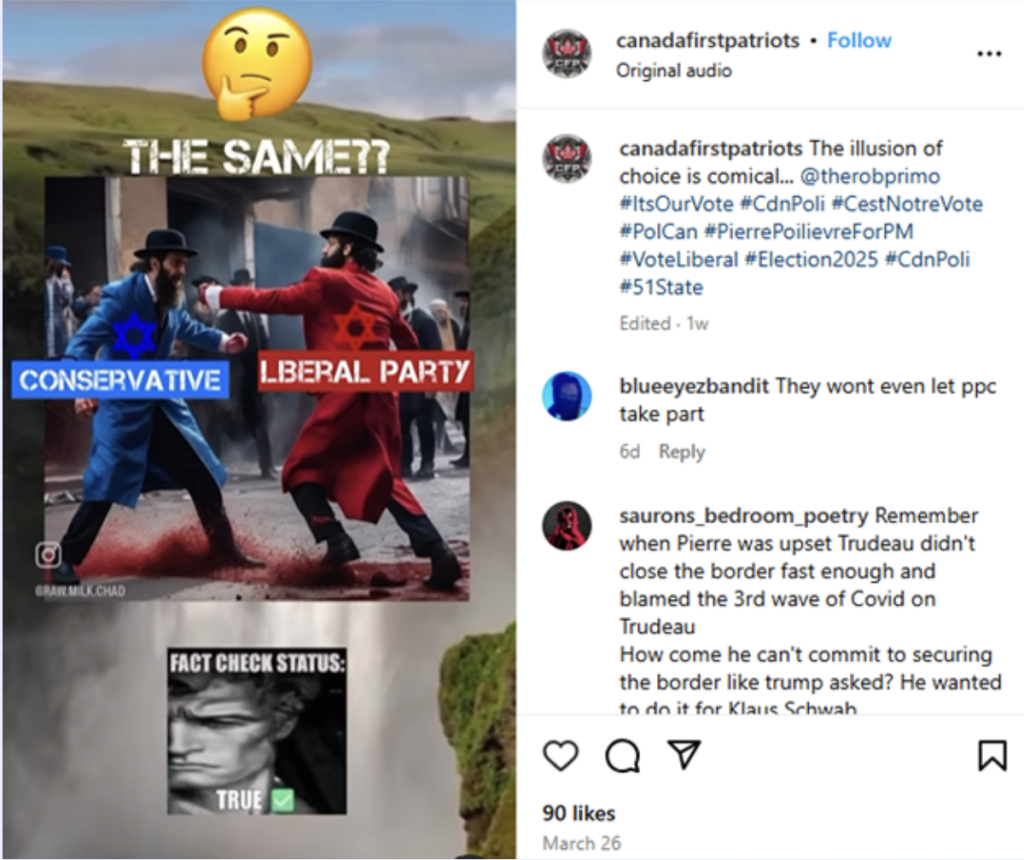
CyberWell identified five primary antisemitic narratives present in the dataset:
- Allegations of Jewish or Israeli control over Canadian politics
- Longstanding conspiracy theories involving the Rothschild family and sexual blackmail
- Comparisons between the Holocaust and the Israel-Hamas conflict
- Classic antisemitic myths and slurs, such as the blood libel, or that Jews are inherently dangerous
- Identity-based attacks targeting Jewish politicians’ religion, appearance, or sexual orientation
Across platforms, X was by far the dominant host of this rhetoric, with 72.1 percent of confirmed antisemitic posts originating on the platform. Only 22 percent of the posts were removed, marking a dramatic drop from CyberWell’s 2024 global average removal rate of 50 percent.
Meta (Facebook and Instagram) removed 72 percent of confirmed antisemitic posts, TikTok 67 percent, and YouTube removed none. Notably, while the YouTube posts identified were antisemitic, only one violated YouTube’s community guidelines. The low number of posts identified on YouTube may be due to YouTube’s guidance explicitly stating that its hate speech policy applies to election-related content. Meta (Facebook and Instagram) and TikTok demonstrated stronger enforcement than X, though CyberWell’s trusted partner status likely contributed to this higher removal rate.
Almost all of the analyzed antisemitic content, 95 percent, fell under Example 2 of the IHRA definition, alleging Jewish domination of politics, media, or finance. This narrative remains deeply embedded in antisemitic political discourse and is one of the most frequently overlooked by enforcement mechanisms, despite being explicitly prohibited under most platforms’ hate speech policies.
“This analysis demonstrates how deeply embedded antisemitic conspiracy theories remain in political discourse and how easily they find traction online,” said CyberWell Founder and Executive Director Tal-Or Cohen Montemayor. “Election cycles are critical flashpoints, and the failure to enforce platform policies against these harmful narratives puts Jewish communities and democratic integrity at risk.”
“Platforms must define and enforce policies surrounding election-related antisemitism with the same urgency they apply to Holocaust denial or other forms of hate speech,” added Cohen Montemayor. “Without precise definitions and stronger proactive moderation tools, online hate will continue to spill into real-world harm, as we have already seen with direct targeting of Jewish politicians across the globe.”
CyberWell’s insights on antisemitic election narratives in Canada are available at: https://cyberwell.org/post/2025-canadian-election-rhetoric-tainted-by-antisemitism/