


WINNIPEG – The story of 1948 is not one of a single community’s trauma. It is the story of two people, two national movements, and two very different choices made in the face of partition and statehood.
Canadian Palestinian Association of Manitoba’s (CPAM) statement frames the CMHR’s planned Nakba exhibit as a long-overdue act of recognition. But a national museum has an obligation not to amplify a partial, one-sided narrative, especially one rooted in political activism rather than historical balance. The issue is not whether Palestinians have stories. They do. The problem is whether the CMHR is about to present a politically curated narrative that erases equally real, equally painful Jewish stories of displacement, and distorts the public’s understanding of how the Arab-Israeli conflict began.
1. The Nakba did not occur in a vacuum — it happened because Arab leaders rejected a peaceful two-state solution.
CPAM writes about “homes left behind,” “wounds,” and “generations of grief.” But they omit the most fundamental fact:
In 1947–48, Arab states and Palestinian leaders rejected the UN Partition and launched a war to destroy the newborn Jewish state.
This war, not an Israeli “plan,” is what turned civilians on both sides into refugees.
You cannot teach “what happened to Palestinians” while erasing what Palestinians and the surrounding Arab world did:
- Rejecting Jewish self-determination
- Vowing to annihilate the Jewish community
- Initiating a civil war and then a regional invasion
A museum dedicated to human rights should not embed selective memory into its exhibits.

2. More than 850,000 Jews were expelled or fled from Arab countries — yet their Nakba is never mentioned.
If intergenerational trauma is the metric, then Mizrahi and Sephardi Jews, who lost their homes, property, and citizenship in Baghdad, Aleppo, Cairo, Tripoli, and beyond, deserve equal space.
Where is the exhibit for their keys?
Their synagogues destroyed?
Their citizenship revoked?
Their families who arrived in Israel with nothing?
CPAM says, “Our story matters.”
Yes, but Jewish stories matter too, and the CMHR has a responsibility to prevent the selective telling of history that invisibilizes one of the largest refugee crises of the 20th century.
3. The claim “Palestinians must shape the exhibit” is dangerous in a national museum.
In personal storytelling, lived experience is essential.
In historical education, objectivity is essential.
A national museum is not an activist platform.
It is not a cultural centre.
It is not a political theatre.
If the only people allowed to “shape” the content are those with a political stake in the narrative, then what the CMHR is preparing is advocacy, not education.
Historical exhibits require:
- historians
- archivists
- multiple perspectives
- verifiable sources
- context
Not a single community dictating the story.
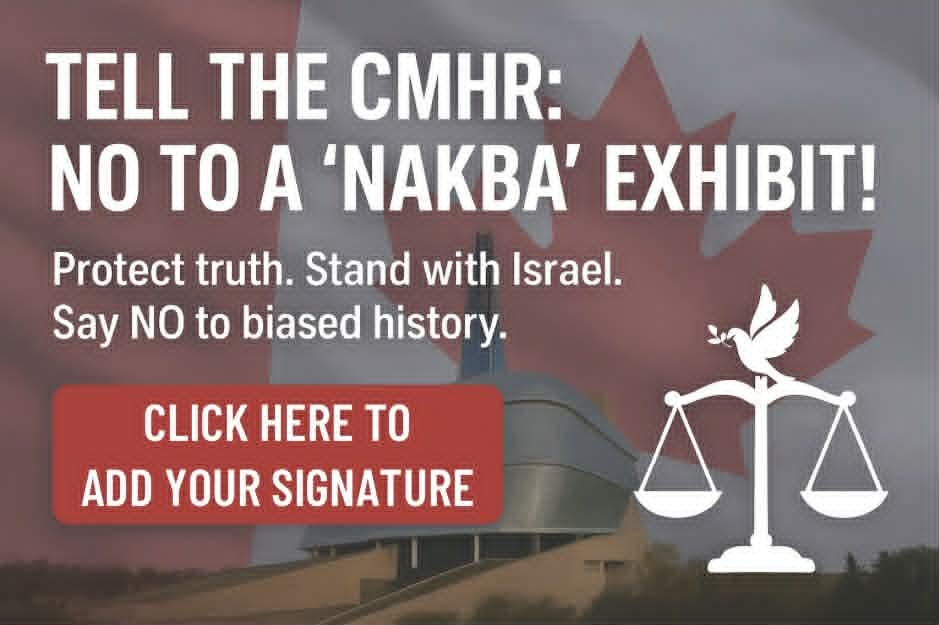
4. Teaching the Nakba without teaching the surrounding context fuels antisemitism, not understanding.
CPAM warns that not educating about the Nakba leads to stereotypes and racism.
But teaching a decontextualized Nakba also does tremendous harm:
- It suggests Israel was born in sin.
- It portrays Jews as colonial intruders rather than an indigenous people returning home.
- It casts Palestinians exclusively as victims while absolving their leaders of any responsibility.
- It fuels the narrative that today’s anti-Israel hostility is justified “resistance.”
This is precisely how anti-Zionism and antisemitism flourish.
A human-rights museum cannot afford to present history in a way that delegitimizes Jewish peoplehood or portrays the creation of Israel as an injustice.
5. A national museum should not endorse a political narrative that ignores Jewish indigeneity and survival.
The Jewish story is not a footnote.
It is not “the other side.”
It is the 3,000-year history of the Jewish people in their homeland, nearly wiped out by foreign conquest, returned after millennia, and then attacked the moment independence was declared.
If the CMHR chooses to display the Nakba as a singular tragedy with singular blame, it:
- distorts history
- undermines reconciliation
- and paints the existence of Israel as a moral error
That is not “justice.”
It is propaganda.

6. Palestinian pain is real — but so is Jewish pain.
The experiences CPAM describes, loss, uprooting, and memory, are human, and they matter.
But Israeli families also have keys.
Jewish refugees from Arab lands also carried nothing but memory and hope.
Holocaust survivors also arrived in 1948 with trauma, loss, and wounds that shaped generations.
Trauma does not confer historical accuracy.
Human pain cannot replace historical context.
And one community’s grief cannot justify erasing another’s history.
Recognition must not come at the price of erasure
A national human rights museum must tell the full story.
Suppose the CMHR is preparing an exhibit crafted exclusively by Palestinian activists, devoid of Jewish context, lacking historical balance, and promoting a political narrative in place of a factual record. Then this is not an “act of justice.”
It is an act of distortion.
True education recognizes that:
- Both people suffered in 1948.
- Both people have stories.
- Both people deserve dignity, not denial of the other’s historical roots or legitimacy.
A museum committed to human rights should bridge understanding, not deepen division.
History must be taught responsibly, or not at all.
