


WINNIPEG – The documented atrocities committed by Hamas on October 7 continue to emerge, revealing acts that international legal experts describe as crimes against humanity. Israeli authorities confirmed that more than 1200 people were murdered in deliberate attacks on civilians. Hostages, including women, children, and the elderly, were taken into Gaza.
Testimony from families and military investigators has described torture, sexual violence, and executions carried out inside medical facilities. Major news outlets have reported on these atrocities, and Israeli officials have supplied video evidence to foreign governments and journalists.
Among the most disturbing revelations are the accounts related to Noa Marciano, an Israeli soldier abducted by Hamas and taken alive into Gaza. Her family told Israeli media organizations that they were shown a video of Noa being executed inside a Gaza hospital by a doctor who injected air into her veins.
According to the family, Hamas distributed this footage to mislead the public and allege she had died in an Israeli strike. These details, which were reported by multiple journalists, including Israeli commentator Hen Mazzig, underscore the deliberate nature of Hamas violence.
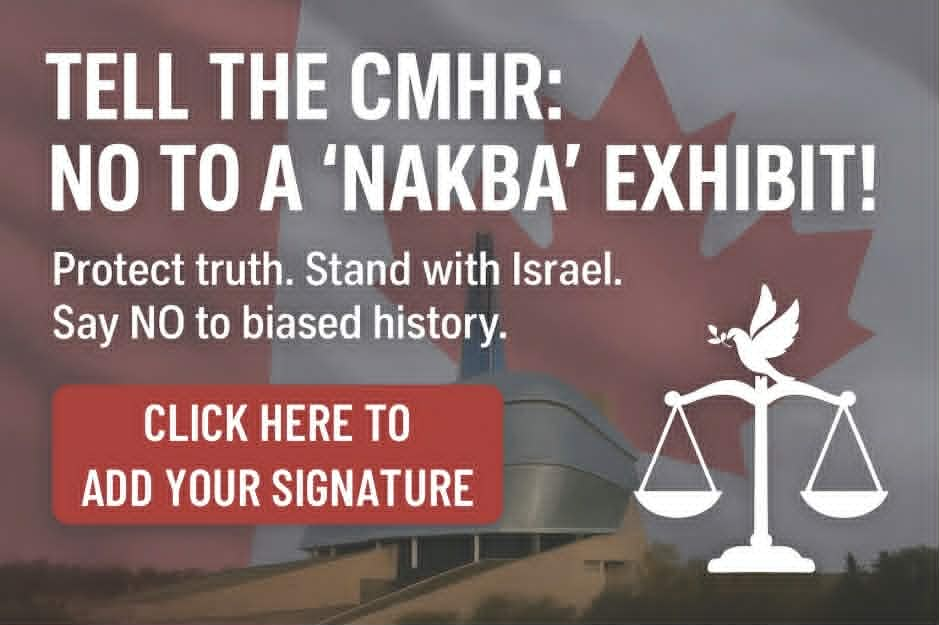
These facts matter because they form the backdrop for an increasingly troubling development in Canada. The Canadian Museum for Human Rights has agreed to host a Nakba exhibit that includes contributions from the Canadian Palestinian Association of Manitoba, also known as CPAM.
As reported by National Post columnist Terry Newman, CPAM has publicly praised Hamas and Hezbollah leaders. Newman wrote that CPAM called Hezbollah’s Hassan Nasrallah “a great leader” and posted celebratory messages following the October 7 attacks.
This raises a central question for Canadians: how can a national human rights institution give its platform to organizations that openly support groups responsible for mass murder, hostage taking, and systematic brutality against civilians?
The CMHR’s mandate is to promote respect for human rights and to enhance public understanding of violations throughout history. Presenting material from a group that supported the events of October 7 risks undermining that mandate. It risks recasting perpetrators as victims and blurring essential distinctions that international law requires institutions to uphold.

The problem is not the discussion of Palestinian history. It is the decision to elevate contributors aligned with extremist rhetoric while ignoring the factual record of Hamas violence. According to the National Post report, CPAM also took positions sympathetic to Hamas shortly after the attacks and has aligned itself with narratives that deny or minimize the group’s responsibility for civilian harm in Gaza.
Human rights scholars have stressed that accountability requires consistent moral standards. Israel withdrew from Gaza in 2005 and has repeatedly been targeted by rocket fire from Gaza, Judea, and Samaria, as well as by cross-border attacks from Lebanon. These threats form the context for Israeli military responses, yet they are rarely acknowledged in public exhibits.
Ignoring Hamas crimes while giving visibility to its apologists risks normalizing antisemitism and delegitimizing the suffering of Israeli victims. It also harms Palestinian civilians by shielding Hamas from scrutiny. As multiple governments, including Canada, classify Hamas as a terrorist organization, the museum’s decision appears inconsistent with federal policy.
The ongoing conflict demands a truthful accounting, not a curated narrative shaped by groups that celebrated mass violence. Canadians deserve institutions that defend universal human rights, including the rights of Israeli civilians targeted by terror groups.
