


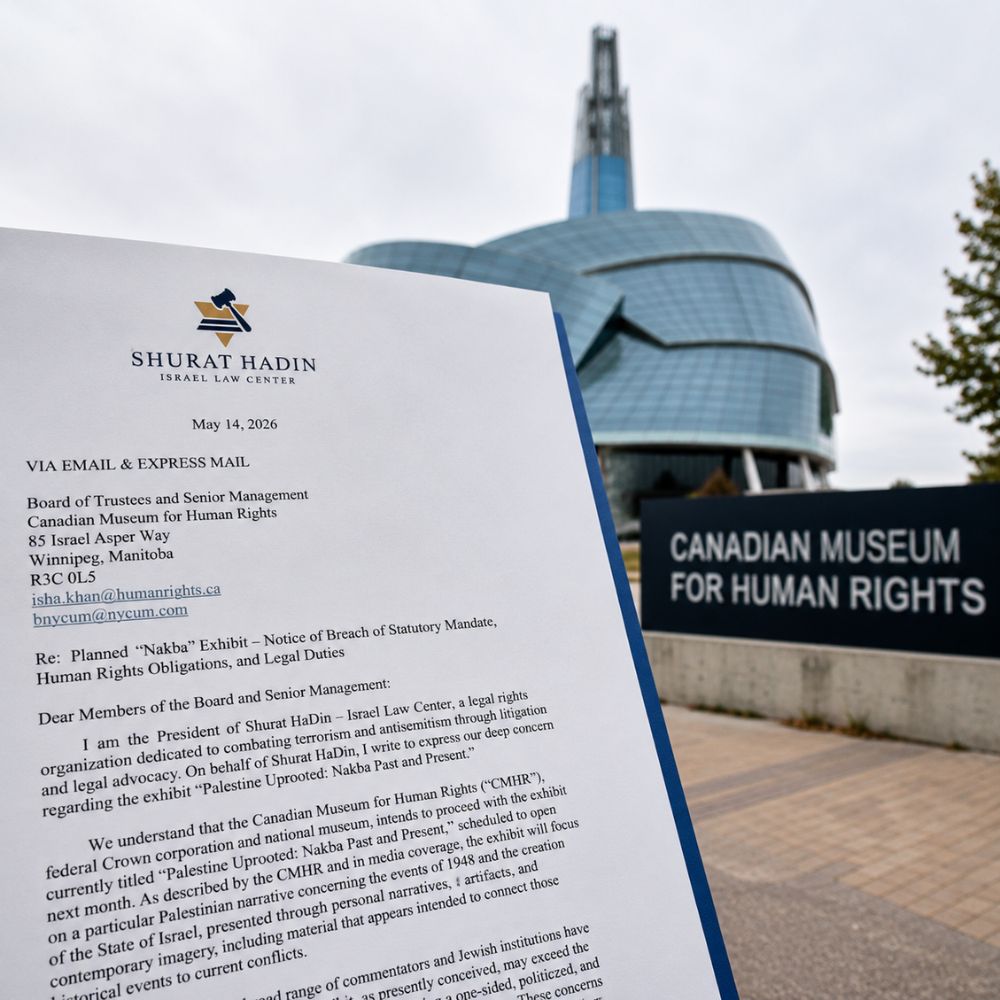


WINNIPEG, Canada — Shurat HaDin – Israel Law Center has issued a formal legal notice to the Canadian Museum for Human Rights (CMHR), warning that the museum’s planned exhibit, “Palestine Uprooted: Nakba Past and Present,” may breach Canadian law, violate the museum’s statutory mandate, and contribute to a hostile environment for Jewish visitors and community members.
The seven-page letter, dated May 14, 2026, was addressed to the CMHR Board of Trustees and senior management in Winnipeg. It was signed by Nitsana Darshan-Leitner, founder and president of Shurat HaDin, an Israeli legal advocacy organization known for litigation and campaigns focused on terrorism, antisemitism, and Israel-related legal issues.
The legal notice alleges that the exhibit, which is expected to focus on the Palestinian narrative surrounding the events of 1948 and the establishment of the State of Israel, risks presenting what the organization describes as a “one-sided, politicized, and historically incomplete narrative lacking balanced scholarly context.”
According to the letter, the concern is not simply about historical interpretation but about the responsibilities of a federally funded national institution.
“The creation of the State of Israel pursuant to international legal and diplomatic processes, including the United Nations partition framework and post-war decolonization efforts, is not, in itself, a human rights violation,” the letter states.
Shurat HaDin argues that portraying Israel’s establishment as a “catastrophe” without broader historical context, including the displacement of Jews from Arab countries and repeated wars initiated against Israel, risks transforming the museum from an educational institution into what it describes as “a platform for partisan political advocacy.”
Allegations Of Institutional Imbalance
The legal notice raises concerns regarding the advisory structure behind the exhibit. Shurat HaDin claims the museum’s Palestinian advisory or steering committee appears “heavily weighted” toward individuals and organizations involved in anti-Israel activism, while allegedly lacking meaningful Jewish or Zionist representation.
The organization also claims that despite assurances from the museum regarding consultations with affected communities, Jewish stakeholders were not meaningfully consulted during the exhibit’s development process.
“We understand that, as a result of the foregoing, several mainstream Jewish organizations have withdrawn from planned collaborations with the CMHR,” the letter states.
The CMHR has not publicly responded to the allegations contained in the legal notice as of publication time.
The exhibit has already become the subject of debate within parts of Winnipeg’s Jewish community and among several Jewish advocacy organizations across Canada.
Human Rights And Defamation Concerns
A significant portion of the letter focuses on concerns related to federal and provincial human rights legislation.
Shurat HaDin argues that as a federal Crown corporation operating in Manitoba, the CMHR must comply with both the Canadian Human Rights Act and Manitoba human rights legislation, which prohibit discrimination and require public institutions to avoid fostering hostile environments for protected groups.
The legal notice states that an exhibit which “delegitimizes Jewish people’s right of self-determination in their historic homeland” or minimizes Jewish suffering could contribute to hostility toward Jews and supporters of Zionism.
The organization further argues that the exhibit could potentially expose the museum to allegations of group defamation under Manitoba law.
“To the extent the exhibit portrays the creation of Israel as inherently criminal, racist, colonialist, or analogous to grave human rights abuses, without balanced historical context,” the letter states, “the exhibit risks causing unrest targeting the Jewish people and Christian Zionists.”
The letter also links these concerns to the broader rise in antisemitism across Canada following the October 7 Hamas attacks and the subsequent war in Gaza.
Educational Programming Under Scrutiny
Shurat HaDin also raised concerns regarding the exhibit’s planned educational programming.
The organization noted that CMHR materials indicate the exhibit could become part of school visits and youth educational initiatives. According to the legal notice, presenting students with what it characterizes as a narrow political narrative while minimizing Jewish historical experience risks distorting understanding of Jewish identity, Zionism, and Israel.
The letter states that a national human rights museum must “model impartiality and openness to multiple perspectives,” particularly when addressing contentious historical subjects.
Formal Demands And Potential Legal Action
In the letter, Shurat HaDin issued several demands to the CMHR, including:
- Immediate suspension of work and public promotion related to the exhibit in its current form.
- An independent legal review regarding compliance with Canadian law and museum standards.
- The creation of a balanced advisory structure including Jewish communal organizations, historians with diverse perspectives, and experts on antisemitism.
- Preservation of all internal documents and communications related to the exhibit.
The legal notice also requested clarification from the museum regarding whether it considers the establishment of the State of Israel to constitute a human rights violation.
Shurat HaDin warned that failure to adequately respond within 14 days could result in legal proceedings.
“Absent a satisfactory response within this timeframe, we will advise our clients that the CMHR has elected to proceed despite clear notice of the legal and reputational risks identified above,” the letter states.
The dispute comes amid broader international debates surrounding museum neutrality, historical memory, and the presentation of contested narratives relating to the Israeli-Palestinian conflict.
The Canadian Museum for Human Rights, which opened in Winnipeg in 2014, was established as Canada’s national museum dedicated to the exploration and promotion of human rights education and dialogue.


What the bigoted ‘gang of 40′ on Wikipedia’ – try to bury:
Nazism among Arab Palestinians
https://archive.is/2tt0U