


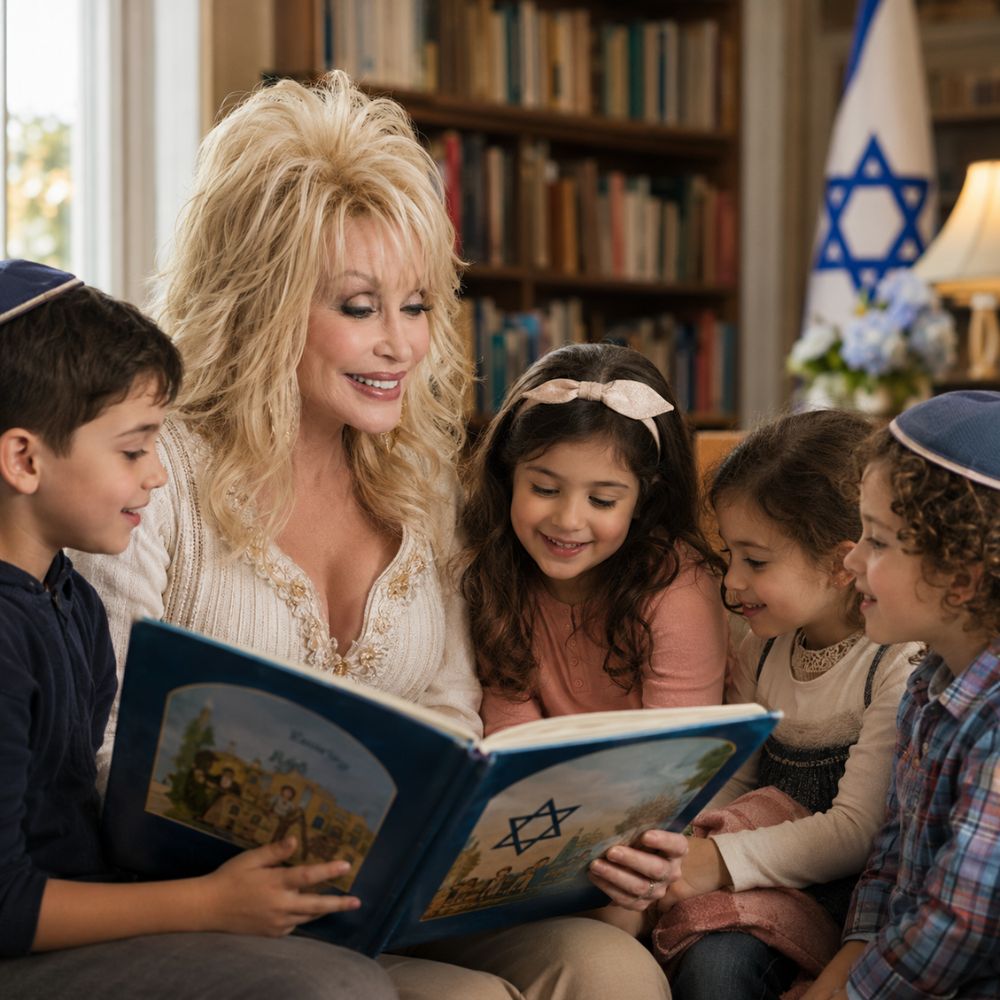

WINNIPEG, CANADA | Dolly Parton will be remembered for the rhinestones, the unmistakable voice, and the songs that became part of the American soundtrack.
She should also be remembered for something far less obvious.
Parton, who died Tuesday at the age of 80, helped inspire one of the most successful Jewish educational initiatives of the modern era. That legacy now reaches Jewish families around the world, strengthens children’s connections to Jewish history and values, and places books about Israel in homes where Jewish identity might otherwise struggle to survive.
Dolly Parton was not Jewish. She was a deeply spiritual Christian whose music grew out of the churches and mountain communities of Tennessee. There is also no reliable evidence that she publicly described herself as a Zionist or adopted an explicit political position on Israel.
Accuracy matters. We do not need to manufacture celebrity endorsements of Zionism.
Parton’s connection to Jewish peoplehood and Israel is more subtle, but also more meaningful. Her example helped build an institution that teaches Jewish children who they are, where they come from, and why Israel matters.
It began with her father.
Robert Lee Parton was an intelligent and hardworking man, but he never had the opportunity to learn to read or write. His illiteracy limited him throughout his life and left a deep impression on his daughter.
In 1995, Parton established the Imagination Library in her home county in Tennessee. The concept was beautifully simple. Children would receive a free, carefully selected book every month from birth until they entered school.
The program expanded far beyond Tennessee. By 2023, it had distributed more than 200 million books. Parton said her father lived long enough to see its success and considered the Imagination Library the accomplishment of hers that made him proudest.
One of the people who heard about the program was Jewish philanthropist Harold Grinspoon.
According to the Harold Grinspoon Foundation, Grinspoon heard Parton discussing her father’s illiteracy during a radio program. He became a local funding partner for the Imagination Library but soon began considering how its model could serve the Jewish people.
The answer became PJ Library.
Launched in 2005, PJ Library began by sending Jewish books to 200 children in western Massachusetts. Its purpose was not merely to improve literacy. It was to bring Judaism into the intimate space of the family home.
The books introduced children to Shabbat, Jewish holidays, biblical stories, Hebrew words, Israel, Jewish ethics and the experiences of Jews from different countries and backgrounds.
Today, PJ Library has more than 670,000 subscribers across five continents. It reaches families ranging from the deeply observant to those with only a fragile connection to organized Jewish life. For many interfaith, unaffiliated or geographically isolated families, a PJ Library book may be among the first Jewish objects their children call their own.
That is not a small accomplishment.
Jewish continuity is not maintained only through declarations, institutions or political campaigns. It is also preserved at bedtime, when a parent opens a book, and a child encounters Abraham and Sarah, Moses, Jerusalem, Shabbat or the Hebrew language for the first time.
In a 2023 interview celebrating PJ Library’s 18th anniversary, Parton said she was honored that her program had inspired Grinspoon.
“I’m always honored when my Imagination Library inspires others, like Harold Grinspoon and PJ Library,” she told PJ Library. “That is so very special to me.”
Her influence eventually reached Israel itself.
PJ Library’s Hebrew-language sister program, Sifriyat Pijama, distributes books through Israeli schools and daycare centers. Children read the stories in class and then bring their copies home, allowing Jewish culture, heritage and values to move from the classroom to the family dinner table.
As of 2024, Sifriyat Pijama reached more than 350,000 Jewish children in Israel. Its Arabic-language companion, Maktabat al-Fanoos, reached another 170,000 Arab Israeli children. Both programs operate with Israel’s Ministry of Education.
After the Hamas massacre of October 7, 2023, the program became more than an educational service.
Israeli communities were evacuated. Schools closed. Families lived in hotels, temporary accommodation and bomb shelters. Children faced sirens, displacement, grief and fear.
Sifriyat Pijama responded by sending thousands of books and activity kits to evacuee centers. It produced Hebrew audiobooks for children listening from shelters and created materials that helped parents and educators discuss fear, loss and uncertainty.
One educator described the packages as a “glimmer of hope in the midst of despair,” according to PJ Library’s account of its emergency work.
The line from Dolly Parton’s childhood home in Tennessee to an Israeli child sheltering during war is not direct, but it is unmistakable.
A daughter saw the pain caused by her father’s illiteracy. She created a program that placed books in children’s hands. A Jewish philanthropist saw that idea and adapted it to strengthen Jewish life. That institution expanded into Israel and ultimately provided familiarity and comfort to children living through the darkest national trauma since the establishment of the Jewish state.
There were other Jewish threads in Parton’s life.
Her beloved “Coat of Many Colors” drew explicitly from the biblical story of Joseph. Her mother used that story to give dignity to the homemade coat she had sewn from scraps. Parton later transformed the experience into a song about poverty, humiliation, maternal love and the difference between material wealth and genuine worth.
She also drew upon Noah and the three Hebrew men who defied Nebuchadnezzar in “The Master’s Hand.” Her career was shaped by Jewish collaborators, including manager Sandy Gallin, producer Gary Klein and the songwriting partnership of Barry Mann and Cynthia Weil.
Gallin helped Parton cross from country music into mainstream entertainment. He also worked with her on Dollywood and their Sandollar production company. Parton once described the unlikely but enduring friendship between a Christian woman from the South and a Jewish man from New York as completely real.
None of this makes Dolly Parton Jewish. It does not justify placing political words in her mouth.
But Zionism, properly understood, is not simply a collection of government policies or campaign slogans. It is the belief that the Jewish people constitute a living nation, that Jewish identity deserves to be transmitted and that Israel is the historic home in which Jewish language, culture and collective life can flourish.
By that measure, the institution inspired by Dolly Parton has produced profoundly Zionist consequences.
PJ Library helps Jewish children see themselves as part of an ancient and continuing people. It introduces diaspora families to Israel. Its Israeli programs preserve Hebrew literature and Jewish heritage. After October 7, it stood beside Israeli families when they were most vulnerable.
Parton’s Jewish legacy therefore offers an important lesson.
You do not have to share someone’s religion to strengthen their community. You do not need to deliver a political speech to defend a people’s future. Sometimes the most enduring act of solidarity is to create something good and allow others to carry that goodness into places you never imagined.
Dolly Parton gave children books.
Those books inspired Jewish books.
Those Jewish books became stories of identity, memory, Israel and belonging.
And somewhere tonight, a Jewish child will ask for one more story before going to sleep, unaware that a country singer from the mountains of Tennessee helped place it in their hands.
TheJ.ca receives no government money. Independent journalism depends on readers who believe these stories must be told. Please consider supporting our efforts.
Stand Proud. Stand Strong. Stand Zionist.


“Accuracy matters. We do not need to manufacture celebrity endorsements of Zionism”
in an article completely manufacturing a celebrity endorsement of zionist, providing not one connection to zionism other than an israeli stealing her kids book club idea
Complete word diarrhea, one of the most retarded articles I’ve ever read in my life
FROM THE RIVER TO THE SEA