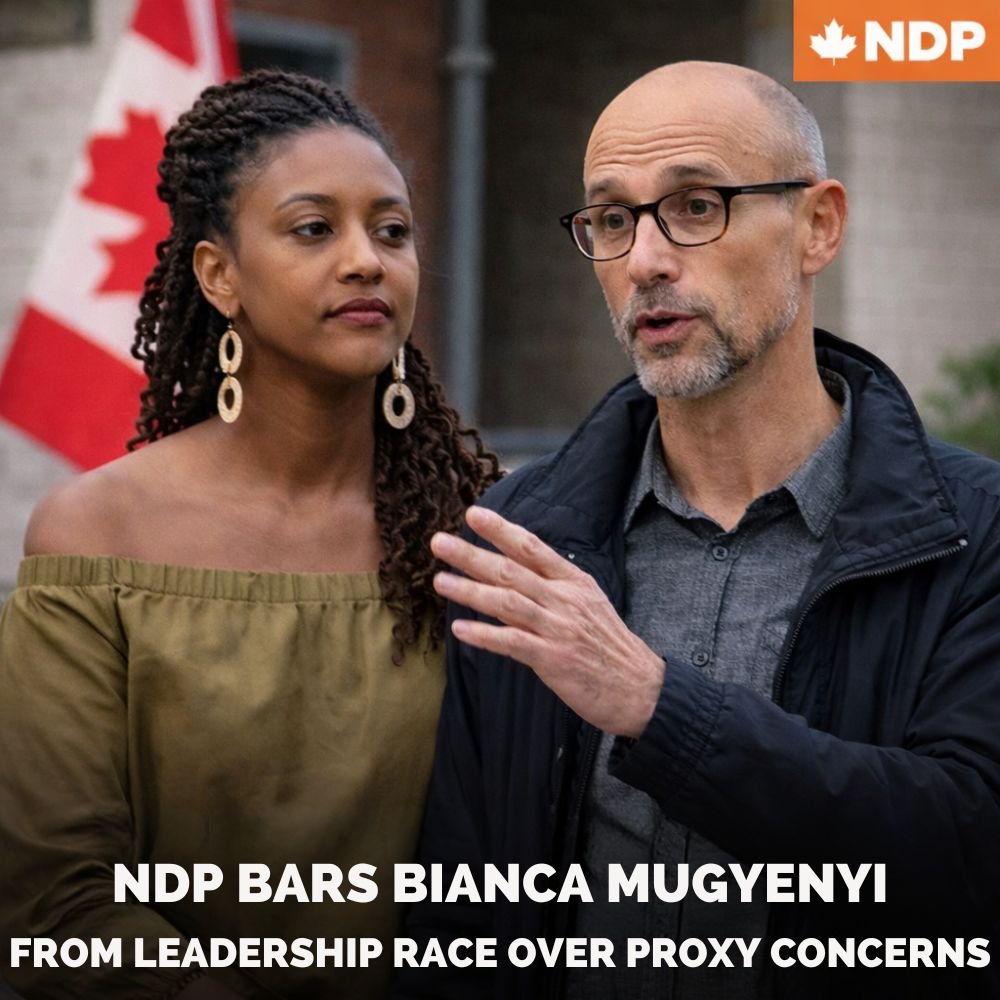


Ottawa – The New Democratic Party has barred Bianca Mugyenyi from entering its federal leadership race, citing concerns that her candidacy would operate as a proxy for her husband, activist and author Yves Engler.
In a statement issued to media outlets, the New Democratic Party confirmed that Mugyenyi was deemed ineligible under party rules governing leadership contests. The party said those rules are designed to ensure candidates act independently and are not advancing the interests or influence of individuals outside the race.
“The leadership process must be fair, transparent, and focused on candidates who are running in their own right,” an NDP spokesperson said in a written statement reported by CBC News. “After reviewing the application, the party concluded that this threshold was not met in this case.”
Mugyenyi is a longtime political activist and the wife of Yves Engler, a Montreal-based writer known for his sharp criticism of Israel, Canadian foreign policy, and mainstream Jewish organizations. Engler has been widely criticized by Jewish advocacy groups for rhetoric they describe as hostile to Zionism and dismissive of antisemitism concerns within progressive movements.
According to reporting by the Canadian Press, the party’s decision followed internal deliberations by the NDP’s leadership contest committee. The committee reviewed Mugyenyi’s application, public statements, and campaign materials before concluding that her bid raised concerns under party bylaws that prohibit “surrogate or proxy candidacies.”
The NDP did not release detailed internal findings but emphasized that the ruling was procedural rather than ideological. “This decision is not about silencing debate or excluding viewpoints,” the spokesperson said. “It is about maintaining confidence in the leadership selection process.”
Mugyenyi rejected the characterization. In a statement posted to social media, she said the decision was politically motivated and unfair. “I am my own person with my own political views and record,” she wrote. “To suggest otherwise is disrespectful and undermines democratic participation.”
Engler also responded publicly, accusing the party of attempting to marginalize dissenting voices on foreign policy, particularly those critical of Israel. “This is about narrowing the spectrum of debate within the NDP,” he said in a blog post published on his website.
The controversy has drawn attention within Jewish and pro-Israel circles, where Engler’s activism has long been a source of concern. Jewish organizations have previously pointed to his commentary on Israel, Hamas, and Jewish communal advocacy as contributing to a hostile environment for Jewish students and institutions in Canada.
In recent years, several Jewish groups have urged Canadian political parties to draw clearer lines between legitimate policy debate and rhetoric that fuels antisemitism. While the NDP did not reference these concerns directly, party officials acknowledged that leadership candidates are subject to heightened scrutiny due to the visibility and influence of the role.
Political analysts say the episode highlights growing tensions within progressive parties over foreign policy, Israel, and the boundaries of acceptable activism. “Leadership races are about brand protection as much as ideas,” said Lori Turnbull, director of the School of Public Administration at Dalhousie University, in comments to Global News. “Parties are extremely sensitive to candidates who could overshadow the campaign or create ongoing controversies.”
The NDP leadership race is expected to attract significant attention as the party positions itself ahead of the next federal election. With debates over foreign policy, Middle East issues, and campus activism increasingly prominent, party officials appear intent on minimizing internal disputes that could distract from core campaign messaging.
For pro-Israel and Jewish observers, the decision is likely to be viewed as a rare instance of a major Canadian party drawing a firm procedural boundary in response to concerns about activist influence. Whether it sets a precedent for future leadership contests remains to be seen.